Friday, June 29, 2012

I want to be green at festivals, but....

green light, stage, hands, black and white,

Summer is an amazing time of the year, complete the sunshine we crave on those cold winter days, ice cream cones, beach days, and music festivals. Every summer I find myself having to carefully budget my finances to allow myself enough disposable income to see my favourite bands play at various different music festivals across this part of the country. Every genre you can imagine finds itself on display in front of heat stroked fans, who in some cases have been camping out in tents in the rain for days taking in the sights and sounds and atmosphere of the music festival scene.

Now a days there seems to be a festival every weekend, and at a growing cost to festival goers. Festivals fight to bring in the hottest bands from around the world, they set up stands to sell over priced food, and drinks, whilst preventing you from bringing in your own. They encourage you to drive, bus, train, and fly from wherever you are, to attend the best, biggest, and hippest festival of the summer. 

Naturally, very little about most music festivals is sustainable, from the inflated prices, to the travel emissions of bands and fans alike, to the ridiculous and I mean ridiculous amount of waste from water bottles and wrappers that is created over the course of the festival. This is changing however. There is an increased drive to make festivals green, but maybe in doing this there should also be more focus on bringing festivals back to the local scene. 

This past weekend I found myself at Ottawa Explosion and I was thrilled with the brilliant display of... well Ottawa. Local talent filled local bars, galleries and courtyards, drawing in local fans to drink local beers, and cumulatively build up the local music and art community. Mind you there were some bands that came from far away, and I’m sure some fans who also covered some far spans of distance to attend, but overwhelmingly it was a homegrown experience. 

Recycling cans were set up and heavily used at all outside events, and local business and bands were supportive. Personally, I’m sold! I’ll be less eager to travel great distances to fly through crowds again, when I can stay home and take in the local scene instead, and reduce my footprint while I’m at it. Long live the local scene!

~ kira - campus sustainability coordinator
photo credit - jonathan rausseo

Tuesday, June 26, 2012

Mobile Community Garden Plots

barrels, plastic, cut in half, outdoors

Let's talk about last summer.
Last summer we inaugurated the community garden in its new space at 649 King Edward (that's right, we won the lottery with that space). It replaced the old location which has become the building footprint for the CAPEA building. Thirty five glorious plots to serve the campus community, not bad.

But we already knew that we wouldn't have enough space to meet the demand of the campus and the Sandy Hill community. So while discussing the issue with the Director of Physical Resources Service, he mentioned how McGill University was toying around with the idea of having planters that could be moved around when needed. Mobile gardens... brilliant!

So the group got together and we talked about want this could look like. We had a few ideas but unfortunately there were so many things to do to get our current community garden off the ground, that we quickly forgot about the mobile gardens idea.

That is until an opportunity to look at them again came up in the Natural Resource Management course this past winter. One group from the Community Service Learning opportunity took a look specifically at mobile community gardens. The group came up with a couple of great ideas and this reignited our excitement in the possibility of mobile community gardens on the uOttawa campus.

Now before I go any further, I should highlight some of the great reasons why mobile gardens are a fantastic idea.

  1. If you don't like where they are, move them
  2. If the space needs to be used for something else, you can push the garden elsewhere without losing your crops
  3. Movable gardens means you can bring them closer to where you are on campus, making them more accessible
  4. The gardens could be placed in certain areas to create interesting architectural features and fun spaces
  5. Come on... use your imagination... these gardens are mobile!!!
So we poked our heads around and found this interesting concept of half-barrel gardens.Perfect, we actually have a bunch of plastic barrels that we recycle every week. But of course, they aren't very deep and we need to find a way to clean / insulate them so that whatever was in them before isn't an issue for the plants we are growing. So like any good scientists... we decided to experiment. 

The Housekeeping and Sanitation team collected some barrels for us (merci les amis!!!) and the guys in the Carpentry Shop cut the barrels and made some handy footings so that they wouldn't tip over (thumbs up mes mecs). And now the fun part; selecting a variety of plants to test out how they are going to grow in our mobile gardens. Of course we need to paint them and we need to place them, but that's the easy stuff. Thanks to the team at Physical Resources and the great ideas from the CSL students, we are well on our way.

So if I had to look into my crystal sustainability ball I would say this, the sky is the limit. We could potentially create gardens all over the campus. We could place them close to spaces that have no green space to plant. We could dress up some of the concrete heavy areas of the campus. Brigitte has already decided that she would like to use the mobile plots as a learning experience for summer campus students. 
What about you? Where should we take this project next?


 ~jON - campus sustainability manager

photo credit - jonathan rausseo


Monday, June 25, 2012

Experimenting with the Health of Our Lakes

lake, multi-coloured, nature, aerial photo

From the humble beginnings of researchers working out of dilapidated trailers, using plywood and tarps to keep the rain off, to the emergence of a modest but highly sophisticated research facility; the Experimental Lakes Area (ELA) has transformed our knowledge of freshwater ecosystems, and produced an impressive body of research; the depth and completeness of which cannot be found elsewhere in the world. Since its creation in 1968 the ELA has faced funding cuts 3 times, previous to the government's most recent cut in the now infamous omnibus bill C-38. The ELAs research has contributed substantially to our understanding of managing algal blooms, acid rain, climate change, mercury pollution, greenhouse gas fluxes from hydroelectric reservoirs, and endocrine-disrupting chemicals.

Dr. Schindler, a renowned scientist in his field was on campus recently, speaking to the importance of preserving this essential research body. Disruptions to funding and research, he argued, compromised the integrity of the data sets making it near impossible for comprehensive findings to be extrapolated from their work, work which has already contributed substantially to our understanding of how our lake ecosystems operate and external variants which might negatively affect them.

With recent cuts and restrictions being put on research facilities and environmental programs, Dr. Schindler argued that Canada is losing its ability to access its own environmental health, and by association its future. Schindler explained that Freshwater lakes across Canada are all facing new challenges at the hand of climate change. Warming lake temperatures are predicted to intensify the eutrophication problems being faced by lakes across the country. This combined with increasing acidification levels of freshwater bodies leading to the reproduction rates of smaller but essential members of the aquatic food chain to bottom out, has led to a grim prognosis for Canadian lakes, especially without monitoring mechanisms in place. 

What this means on a larger scale is not just the collapse of fish stocks and subsequently the inland fishing industry, nor the continual toxification of one of Canada’s most important natural resources, and unpredictable consequences to surrounding ecosystems that will result from it. If unchecked the degradation of our freshwater bodies will also have a tremendous impact on indigenous communities, particularly of the north, as the lakes in that region are more sensitive to temperature and acidity variations. “If we don’t do something to stop this, and soon, we are going to see a huge shift in the economic and cultural climate in this country” Dr. Schindler stressed.

Unless the ELA is able to find alternative funding for its research, it will find itself sleeping with the fishies by this time next year. With it will go years of invaluable research and our ability to monitor the health of what is arguably our most valuable natural resource.

Dr. Schindler visited the University of Ottawa last week to speak about these issues. He was passionate, he was articulate, and he was looking for our help as he denounced the cuts to the program. Its seems rare that something so important gets announced at the University, but why is that? The University is a research intensive environment and this topic affects research, and not only that it affects research that is being done by the uOttawa community.

We often think of scientists as dispassionate individuals that function on the merits of logic only (Vulcan culture as it were). But our society is enriched by the passion of those who want to make a better planet. Can't scientists be activists too, especially when it comes to such an important issue as the environmental health of our lakes?

~kira - campus sustainability coordinator
photo credit - jonathan rausseo

Friday, June 22, 2012

There is regret, there is deep regret, and then there is the Emerald Ash Borer


Last summer I wrote about my project concerning the Emerald Ash Borers in Sandy Hill- mostly how Jon pimped me out to a prof and his student to look into the situation (because of my mapping expertise). I spent some time hitting the pavement, plotting out where the ash trees were, and locating spaces to plant new trees to replace the canopy cover that would be eliminated by this pesky invasive species. After identifying the areas, we went door to door and spoke to residents about planting a tree on their property with the help of a City grant. It went pretty well, I had some neat conversations with residents, I was able to breathe some fresh air, and I had a change of scenery from the office.

It was great to be done with that project, knowing that the Action Sandy Hill community group had my finalized map in their hands. Effectively they could go about informing more residents and even inoculating trees that were significant to the community and had shown no signs of infection. Inoculation is rather expensive but it can be used for trees that were described to me as being monumental- like an old ash tree in a park that provides canopy cover. Anyways, I left my finished product in their hands with my hopes held high for the ash in Sandy Hill.

Cut to this morning when I get an email in my work inbox:

“The Ottawa area is being invaded with Emerald Ash Borers (EAB) and damage caused on campus is substantial. In order to limit the spread of this pest and to prevent incidents, the University of Ottawa will initiate an ash tree replacement program to resolve the problematic EAB issue on campus. EAB is highly destructive and the only approved treatment in Canada would be unsuccessful due to the severity of this infestation. The ash will be replaced by a wide variety of trees specially selected to proliferate in the surrounding conditions and avoid similar epidemics. The program will be underway within the next few weeks and will spread over 2 years. For more information on EAB, please visit the City of Ottawa’s page: http://www.ottawa.ca/en/env_water/tlg/trees/preservation/eab/.”

Not news for myself, so I speak with my boss because I was wondering if somehow it was linked to my project from last summer. Unfortunately it isn't; some large ash trees on campus have been infected and now they must be removed and replaced.

Le sigh, all last summer I was so worried about Sandy Hill that I had completely waved the possibility of the campus even having ash trees. It’s weird how you don’t think these things will happen to you, on your own campus… but they do. Alas, hopefully we will plant some new trees that will be resistant to people’s ignorance [a.k.a transporting invasive species and assisting in their proliferation].

Disgruntled,

~meriss - campus sustainability coordinator
photo credit - Living with Insects Blog

Wednesday, June 20, 2012

A Real Life Free Store

mug, tag, free, uOttawa

Ten years ago when I was a student at the University of Ottawa, I had this magical dream of something called a Free Store. I had heard from my friends that Carleton University had one and I instantly had to have one on my campus. I had never seen one for myself but I imagined that this incredible space would house row upon row of all manner of useful items. The walls would be adorned with beautifully framed pictures, the floors we be flooded with thick velvety carpets, and I would be able to spend hours just sifting through the sea of one of a kind knick-knacks.

Did I ever feel like a tool when I saw that the Free Store was nothing more than 5 boxes in the corner of a small student office. Apparently when there were enough people, they would put the boxes on the desk to make them easier to rummage through. Pfft, I was crushed.
So a year later OPIRG hosted a Clothing Swap at the University of Ottawa. It was fun, there were at least 8 garbage bags worth of clothes and one rack to hang some of them up on. A lot of people came by and swapped for some new stuff... but I won't lie, it wasn't the magical place that I originally dreamed of. Nevertheless we did eventually create a Free Store on campus; a fairly formidable one at that. (You can read about the evolution of the uOttawa store at the older post.)

We had some really crazy times with our Free Store this past year, including an almost near riot. But again, our Free Store was always just a few tables that we spread out in the UCU with some open boxes. Nothing ever lived up to that idealized space that I had conjured up oh so many years ago... until now. Yes, the rumours are true, we are creating a real life Free Store.

The details are still being finalized but this is what I can tell you:
  1. The Free Store will be in one of the houses on King Edward. We have already scoped out the space and installed some of the fixtures.
  2. We will have a permanent donation box. We were able to find a giant crate and add a handle to it. So now we can take donations 24/7 in one centralized location.
  3. We have our own washer and dryer. Of course we always encourage everyone to clean anything they get at the Free Store but now we can get rid of any particularly unsavoury stains and dubious odours.
  4. The Free Store will become a hub for donations to communities in need. We have a fair deal of sorting space in the store so we will be making sure that priority donations go to the places that need it most.
What's in store for the space? Well that depends on how the community would like to see us develop it. The Free Store could become a resource for clothing swap parties, educational seminars on consumption and waste disposal, resource centre for social work... the sky is the limit!

~jON - campus sustainability manager
photo credit - jonathan rausseo

sign, red, tape


Monday, June 18, 2012

Unsustainable


There are many examples of unsustainable things going on in the world and here are a few I’ve read about or seen going on in Canada.

Unsustainable, the amount of pressure we put on the soil for commercial clear cutting of forests; soil can no longer retain water thus the landscape is destroyed.

Unsustainable, one of the world’s dirtiest industries, “the oil sands production generates three times the greenhouse gas emission as a barrel of conventional oil”*. Up to 4 barrels of water are used to produce 1 barrel of tar sand oil “resulting in gigantic tailings [pools] of toxic waste that can be seen from outer space by the naked eye”**. This water is drained from the Athabasca (which in Cree means where there are plants one after another - will we have to change the name soon?) River in Alberta.

Unsustainable, our Canadian mining industry is among the biggest in the world and also involved in 33% of mining conflicts (whether “taking over land abroad and polluting water sources, destroying the environment, and often without consulting the affected communities or listened to their concern”) between 1999-2009***. In October 2010, Bill C-300, which is the so-called responsible Mining Bill on corporate accountability of mining companies abroad (to target mostly developing countries) and created by our Liberals was put to final vote in the House of Commons and rejected by most MPs, many Liberal MPs didn’t even show for the vote, did they ever take the bill seriously?

Unsustainable, the environment’s priority shifted from top to the near bottom in the Conservative’s new 2012 budget. The Canadian government is taking the money from environmental budgets and putting it into the oil industry pockets and cutting funds on environmental related industries and pushing downward investment in anything related to climate change like the closing of Eureka, a research base camp and a Canadian meteorological station on Ellesmere Island in Nunavut (Arctic).

Unsustainable, cutting programs like Katimavik, “Canada’s leading youth volunteer-service program that gives youth the chance to take part in intensive service and learning projects that help change the Canadian communities”**** This includes helping the uOttawa sustainability community and Sandy Hill to be even more sustainable year after year.

Sustainable, the water used to water our lawns and cars could come from a grey water sources for instance from rain barrels that you can put under your gutter to recuperate rain water. The City of Ottawa actually funds (50$) to people who want to buy rain barrels (http://rainbarrel.ca/sales/, look up Ottawa on the page to see when they are being offered). Water is a precious resource and we have the tools to keep it clean, the use of grey water is an excellent initiative and a first step in preserving this precious resource.

Sustainable, innovation, investment and the creation of jobs in our burgeoning sustainable energy industries - like solar energy, geothermal electricity, wind power, and hydraulic power.

Sustainable mining is possible. Taking a more sustainable approach toward the environment and involving stakeholder communities is essential. Taking the fuel industry a step further by investing more money into cleaning tar sand effluent before putting it back in nature. Maybe these organizations could invest in more sustainable energy industries and slow down the tar sand industries.

There are many ways our Canada can be more sustainable, I could write for days and list many great sustainable industries but unfortunately, I don’t have a lot of time. But many together the Canadian population could sacrifice a few minutes a day to take action, being more sustainable it is soooooo easy.

If you are looking for more info, all these issues and more are going to be discussed at the Earth Summit in Rio right now. Check out what groups like We Canada are doing to help make Canada more sustainable at the international stage.

~ alex - campus sustainability coordinator
photo credit - jonathan rausseo


* Canada’s Tar sands, Cal project, http://www.calproject.org/factsheet-ibcc-tarsands.pdf, consulted on june 12th 2012.
** Ibid, Canada’s Tar sands.
*** Ownership of companies involved in mining conflicts 1999-2009,2010, Responsible mining – What next?, Canadian catholic organization for Development and Peace, http://youth.devp.org/tag/mining/, consulted on june 12th 2012.
**** Katimavik programs, Katimavik, http://www.katimavik.org/programs/all, consulted on june 12th 2012.

Tuesday, June 12, 2012

Wunderkammer


L’été est la saison pour le ménage intense, les boutiques dans le marcher By et la sangria dans le jardin. Si l’on désire marier ménage et boutiques, je vous recommande d’aller faire un tour au Wunderkammer sur la rue Dalhousie. C’est une boutique éclectique, inétressante et toujour surprenante.

The store’s efforts to re-use vintage jewellery and leather goes to show how being green can actually be very cool. If you have some old jewellery, accessories or even wallpaper hanging around your house or apartment, the artists would love to have it. And you could get up to 30% off your purchase. How can anyone resist that? And the staff/artists are absolutely fabulous. Upon calling the store, I had a great conversation with Nathan who was nice enough to take the time to explain the whole concept of the Spring Cleaning Event happening on June 14th, from 6 - 9 pm.

The whole idea of the swapping sale began with the artists going to the United States to dig up vintage components in order to recycle and give them a second life. Now that the store has been open for about 6 or 7 months, the owners wanted to see what they could do with customers’ broken chains, a lone earring or even bigger items such as wallpaper and postcards. The event is meant to be interactive.

Perso, j’ai tellement hâte d’aller fouiller dans mes vieilles boîtes afin de voir ce que je peux trouver. Je serai curieuse de voir ce qu’ils pourront en faire.

Pour plus d’information, visitez leur événement sur facebook!

~ katherine - campus sustainability coordinator
photo credit - jonathan rausseo

Monday, June 11, 2012

Sustainable Zombie Apocalypse Survival Kit

girl, blood, plant, pile of donations, mask, zombie

In lieu of the recent Zombie outbreak in Miami Florida, we here at the Office of Campus Sustainability, are taking all measures to ensure our safe and sustainable future. We have decided to share with you tips to creating your own sustainable Zombie Apocalypse Survival Kit (some items available at the Free Store).

Basic Tools and Supplies


  • Water: Keeping in mind issues with water depletion and privatization, we suggest purchasing a water filtration device. This not only provides you with greater access to water sources, but the freedom from heavy and burdensome packs of water. One gallon of water per person per day for at least three days, for drinking and sanitation is recommended. Luckily filters can be used numerous times before being replaced. Think about how much faster you’ll be escaping those Zombies now!
  • Food: Local is the way for your gourmet meals on the go! So in preparation for the upcoming Zombie apocalypse head to your local farmers market and find your favourite organic fruits and vegetables. By dehydrating them, and creating preserves, you can keep food longer, and easier, while being green and eating local. We suggest t at least a three-day supply of food, and bringing with you a guide book on local edible flora to help supplement your diet, and enjoy the wonderful taste sensations the Canadian Shield has to offer. Wired Magazine offers this great Food Without A Fridge concept
  • Solar powered or hand crank radio and a NOAA Weather Radio with tone alert. However given that a Zombie Apocalypse is upon you, you may want to brush up on your weather preparedness/survival skills, because well it’s only a matter of time till the Radios are compromised and the Zombies hit the airwaves again.
 
  • First aid kit, just in case. However this isn’t to be used against Zombie inflicted injuries. In the incident of Zombie inflicted injuries please contact your local Zombie community group, I’m sure they will happily provide you with information pamphlets to better integrate you into your new life as a Zombie.

  • Biodegradable soap, recycled or biodegradable garbage bags for personal sanitation. You don't want to leave any traces of where you were just in case the zombies are any sort of intelligent.
  • Can opener for food (if kit contains canned food). However, you may find it difficult to recycle your cans using traditional methods, so we suggest you put on that creativity hat that you’ve locked away in your cupboard, and find your own creative ways to recycle. For instance, using your old cans to boil water in, make stilts out of them, save them for your Halloween costume as the tin man from the Wizard of Oz, or more realistically create awesome armor for your post-apocalyptic larping crew.
  • Local maps. As any good geography student knows (and as Merissa consistently reminds us), you can never overvalue a good map. Additionally maps are more sustainable, if well maintained. Not only are you reducing the amount of chemicals and metals that are used in GPS’s and cell phones, but it’s highly likely that you may not have access to these systems in the middle of a zombie – human faceoff. There is no app that can beat a good ol’ fashion map!
  • Emergency reference material such as a first aid book survival manuals, of course printed on 100% recycled materials because, the post-apocalyptic future doesn’t have to contain post-consumer waste
  • A sleeping bag or warm blanket for each person is advisable. Consider additional bedding if you live in a cold-weather climate. Additionally clothing may also be handy, for hygiene, or in case something gets wet, or for those in prompt to fashion emergencies, like you run into a zombie wearing the same thing as you. Remember a zombie apocalypse is not an excuse to commit fashion crimes, so feel free to stop by the UOttawa free store and battle zombies in style. The UOttawa Free Store, we got you covered for all your zombie apocalyptic needs.
  • Feminine supplies = the Diva Cup!
  • A good book to keep you amused on those days off from Zombie chasing. May I suggest the Silent Spring.
 ~kira - campus sustainability coordinator
photo credit - jonathan rausseo and kira lamont

Saturday, June 9, 2012

Upcyclin’ the Student Life


In lieu of Jon’s recent blog on turning wooden pallets into furniture, I decided to write my own blog on sustainable student living. Mostly because I have found myself since I started university to be very anti-Ikea. Now, don’t get me wrong, I am sure the Swedes have a lot of unique, mass produced, and cheap furniture to adorn your apartment with (you may sense some sarcasm and contradictions, I apologize Ikea lovers) but maybe I am just too crafty or cheap to commit to buying things. Thus, I have upcycled many a thing since I’ve moved to Ottawa.

My tips:

Find friends that are moving, or strangers, around the end of the month and pester them for shit they don’t feel like carrying to a new place, or scour the streets on the night before garbage day .This is how I have acquired the majority of my stuff; whether coming across it randomly when walking home or through friends that had no interest in packing it away and transporting it.

Once you have found some stuff, customize it! This can be fairly inexpensive depending on your ambition and creative talents. My personal favourite is just sanding items down and staining them a certain colour, or even just spray painting things. I picked up a disgusting pink IKEA desk (yes, coincidentally I have never purchased a thing at Ikea but seem to own a fair bit through FREEGAN means) and spray painted it black to match some of my other stuff (including a FREE black Ikea bookshelf). It does not take much time or effort and gives you a sense of accomplishment when finished.

Incorporate GREEN in your DIY projects. Most of your upcycling student furnishing are inherently green as you’re saving these items from the dump but you should also consider adding a bit of greenery here and there. I’m talking specifically to gardening at this time of the year. I recently manufactured a garden:

Ingredients:

  • Twine (I had hemp laying around from bracelet making- typical enviro geek)
  • Cloth shoe/shelving for closets (got mine free from the Dump n Run)
  • If you can’t get your hands on some, try scouring the neighbourhood the night before garbage day because you could come across old suitcases, wrecked desk and drawers, some other device that would work for holding your soil
  • Soil (well, I got lucky because we had extra from Community Garden but you can always employ a friend, family member to join you in a bike expedition to a local soil salesperson)
*tadaaaa, insert plants and love here*

What, you don’t have the money for plants? Try starting your own—such as with green onions that can be restarted and replanted by simply placing them in water on a sill that gets adequate light and transported to soil once they have taken off.


Get creative! We hope to incorporate some DIY student living into our Permanent Free Store location and would appreciate your input on what we should do (need creative storage ideas).

~ Merissa - campus sustainability coordinator
photo credit - cutedecision.com

Wednesday, June 6, 2012

Impacts du Déposez et dégagez sur la communauté: l'abri pour les jeunes femmes Evelyn Horne


Lors des quatre dernières années, nous avons fait don de plus de 70% du matériel amassé lors du déposez et dégagez; nous choisissons des organismes de bienfaisance locales qui distribuent les articles directement aux personnes en besoin (versus un organisme qui revendrais les articles). Nous avons une liste de plus de 15 organismes qui recueillent des articles particuliers pour leurs opérations; p ex. un abri aurait besoin de couvertes et oreillers, et un centre de placement aurait besoin des vêtements et articles de cuisine.

 Faire la tournée de dons est une expérience révélatrice; nous avons la chance de voir à quel point nous pouvons aider des personnes en besoin (et à quel point nous sommes chanceux d’avoir tout ce qu’on a). Voici le profil d’un des organismes ‘l’abri pour jeunes femmes Evelyn Horne’ :

« Ce programme offre aux jeunes femmes âgées de 12 à 20 ans l’accès immédiat à un logement sécuritaire. Ouvert 365 jours par année, l’Abri pour jeunes femmes Evelyn Horne est toujours prêt à accueillir des jeunes femmes qui n’ont pas d’autre issue. L’abri est doté de 30 lits et offre un abri d’urgence et un logement de transition pour une période maximale de un an.

Un environnement culturellement sensible et qui se voit accueillant aux femmes lesbiennes/bisexuelles/transgenres, l’abri offre un endroit sécuritaire pour toutes les jeunes femmes. Chaque jeune femme discute de sa situation unique avec le personnel de l’abri, qui travaille avec elle dans le but de cerner ses besoins et de la jumeler aux services dont elle peut avoir besoin pour atteindre l’autonomie. Une équipe diverse et formée exclusivement de femmes est disponible pour appuyer les jeunes femmes jour ou nuit.

Les jeunes femmes qui ne jouissent pas d’un soutien familial sont jumelées à des travailleuses auprès des jeunes qui les aident à élaborer un plan communautaire et à acquérir les aptitudes dont elles ont besoin pour vivre de façon autonome.

Les abris aident également les jeunes à demeurer en santé au moyen de renseignements sur la santé sexuelle et la toxicomanie, dans un environnement sécuritaire et qui ne porte pas de jugement.

Dans le cas des jeunes femmes de 16 à 21 ans, le logement de transition est offert pour des séjours d’une durée maximale de un an. Ces unités donnent aux jeunes l’occasion de vivre de façon semi-autonome alors qu’ils travaillent à atteindre leurs buts. »

Voici quelques témoignages de jeunes qui ont été aidés.

Donc, merci pour vos dons et votre aide lors du Déposez et dégagez 2012; votre aide renfonce réellement notre communauté.

~brigitte - coordonnatrice de recyclage
photo credit - Lindsay Siu (Directions Youth Services Centre)

Tuesday, June 5, 2012

Maybe it's a language thing?

parchment, paper, type font, green, definition, durable

I come from a bilingual family. Growing up, I’d speak French with my mom and English with my dad, went to school in French and was part of a youth orchestra in Ottawa (mostly anglophones). Hence, I did read Harry Potter in English and speak it fluently, but I had what some people called “a cute French accent” till I was about 14 and decided to get rid of it. 


But this bilingualism thing made for some very interesting conversations now that I think of it. When I was hanging out with my friends at school, we’d be gossiping about who had a crush on who and so on. So when I hung out with my anglophone orchestra buddies, we’d do the same. But sometimes it just came out wrong : “So do you think he has a kick on her? He was totally cruising her!”. See, in French “un kick” is slang for a crush and “cruiser” is slang for flirting. Now that I think about it, it must have sounded very violent and weird. But I didn’t know better and was sure what I was saying was clear. I mean, they were frenchified English words after all. 


It’s only an example of many awkward things I said and I learned English teenage slang the hard way. But it just goes to show how good intentions can go awry. Even during orchestra rehearsals I managed to say/do the wrong thing. As you may know, musical notes aren’t called the same in French and in English. So when the conductor would say the high C in the violins was out of tune, I would play a B (si - which incidentally sounds like C).

I’m kind of hoping now that it would explain many environmental and social blunders and mishaps. What if it was a language thing? The mind wanted to say one thing, but brain just used the wrong words. Instead of “We’re cutting the Katimavik program”, maybe the budget was actually saying “We love Katimavik and will be investing into making it awesome”.


Here's to hoping that this time it was just a translation thing.


~kath - campus sustainability coordinator
photo credit - jonathan rausseo

Sunday, June 3, 2012

SILENCE ON PARLE | BLACK OUT SPEAK OUT


Wooden Pallet Table or DIY Student Furniture?


I recently moved into a new condo, a very easy decision for me to make as an environmentalist. Condos use less resources per capita than houses do and my condo is seeking a LEED Silver certification. There was only one sticking point... I wanted access to a backyard, which is tough for a condo. But I was lucky and bought a place with a big enough balcony that there are planters.

So there I am, got my condo, got my sort of backyard, all I needed was some patio furniture. Here is where things get complicated, basically because of my brother. His advice was simple "What are you stupid? Don't buy your furniture now... wait until the end of the season and get a high quality patio set for a quarter of the price."

And since I am broke now, this kind of made sense to me. But what do I do for the rest of the summer, sit on milk crates? Luckily Brigitte came to my rescue and shared a couple of sites with me about pallet furniture. This site is a pretty good representation of what she shared with me. Of course after seeing these sites, I had to make my own wooden pallet table.

I won't go into the gory construction details but I got my table made and I think that it will last me the entire season (and maybe some more). The pallets came courtesy of the local back alley and the legs for the table were abandoned from the furniture recycling program.And now that the table is done I keep thinking to myself, why don't more people do this kind of thing?

Naturally my thoughts went to students. We are just finishing up the Dump & Run on campus and there is a lot of furniture getting tossed into the garbage (Ikea is over represented by a factor of ten). Why not make more furniture out of pallets? Using pallets is a form of reuse / recycling; pallets are everywhere in the City; getting people to use their hands a bit more wouldn't be a bad thing.

The University of Ottawa has to manage thousands of pallets from the many deliveries to the campus. And the waste bins on campus are overflowing with cheap furniture that couldn't make it past one academic year. And the campus community does have a tonne of creative and industrious people that are willing to get their hands a little dirty.

So what do you think? Maybe the University could set up a workshop space for students to make some pallet furniture? Maybe we could post a community created DIY catalogue of all the different furniture people could make? Maybe we could start a movement to wake people up to the fact that nothing is waste?

One of the biggest arguments that I have gotten about this idea is that the furniture wouldn't be stylish enough and that we would be perpetuating an image of student poverty (the poor student can't afford real furniture). Hogwash!!! - or whatever vegan alternative to this phrase fits better. I think that pallet furniture is just as stylish as any other and Ikea alternative. In today's society, being green is sexy.

~jon - campus sustainability manager
photo credit - jonathan rausseo


Friday, June 1, 2012

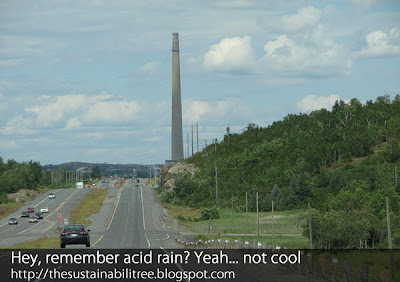
Hey remember acid rain? Yeah... not cool

Smokestack, highway, Sudbury, landscape

As I drive along a road to my grand-father’s house on the week-end, I can’t help but notice the monster smokestacks that spoil Sudbury’s landscape. They can be spotted from miles away; towering over the (unusually) short vegetation and blackened granite. You can actually see a line where the exposed rocks have been blackened, and the recently broken or weathered rocks are pink and light grey (their natural color). Then it happened; a terribly geeky science moment! I remembered reading about acid rain problems in Sudbury being the cause for the lack of lush forest and bountiful wildlife; all because of the mega-smokestacks:

Acid rain is produced when pollutants such as sulfur dioxide (SO2) are chemically transformed to sulphuric acid in the atmosphere; they are then transported and eventually deposited in the form of rain or snow. Over 90% of acid rain in North America is the result of burning fossil fuels for energy (such as coal), and more importantly smelting or refining sulphur-bearing metal ores (Sudbury – NICKEL SMELTING!).

Over 100 years of nickel smelting by companies like Inco and Falconbridge near Sudbury shocked the surrounding landscape and waters. Acidic smelter emissions contaminated the air, and species’ pH tolerance limits were exceeded. The vast forest basically disappeared (hundreds of kilometres) along with the aquatic life of the beautiful lakes. Much of the worst damage was done in the early years of operation, when the ore was smelted over huge, open wood fires.

Smokestack, snow, Sudbury, landscape

Since the 1970’s, due to public and media concern (thank you!), new smelting processes and the construction of high smokestacks (including the 391 meter superstack in the picture) have reduced the local and overall impacts of emissions; however, the smokestacks simply sent the polluted air somewhere else. Again, due to public pressure, in 1985, the Ontario government unveiled its Countdown Acid Rain Program, which required Inco to decrease its containment of SO2 by 90%. In 1994, the company met the government’s deadline for reducing SO2 emissions to a maximum annual level of 265 000 tones.

As Sudbury’s air quality improved, and as lake water quality also improved, extensive land and aquatic restoration efforts began. From 1981 through 1998, thousands of students and others helped reclaim 4700 hectares of heavily degraded land. Limed, fertilized, and planted with grasses, legumes and millions of shrubs, conifers, and hardwood trees, Sudbury’s landscape is recovering. Insects, birds, and mammals are coming back. An unexpected ecological benefit – the decline in lake and river acidity – has prompted efforts to restore aquatic systems as well.

If you ever visit Sudbury, stop along the road to look at the blackened land and restoring vegetation. This is a great example of a human-made environmental disaster; we did not take the time to study the impacts of the expanding smelting industry before it was too late, and we reacted rather than prevented.

*All this wonderful science information camp from my first year Envirionmental Sciences textbook - Our Environment : A Canadian Perspective by Draper and Reed

~ brige - waste diversion coordinator
photo credit - brigitte morin